Monday, March 19, 2018

#NephMadness Living Kidney Donor Case Challenge #LKDCC #1


Rajiv, 39, wants to donate a kidney to his sister-in-law, Shen. His brother, Shen’s husband, is healthy, but unfortunately not a good match for Shen. Rajiv has no past medical history, is a non-smoker and his BMI is 24. His BP is measured at 120/75. Physical examination and urinalysis are unremarkable. Rajiv’s wife is particularly concerned about the future risks to Rajiv.

Which of the following would you advise?
A) After donation, Rajiv has a higher risk of developing ESKD than the general population.
B) After donation, Rajiv may be more likely to develop ESKD than his healthy 37 year-old brother.
C) Annual urinalysis & BP monitoring is recommended only for the first five years after donation.
D) Rajiv’s wife’s concerns are not relevant to the decision-making process.


Here's how you responded:
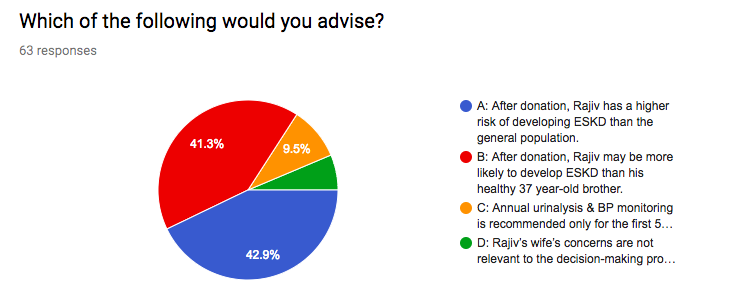

Correct Answer: B
For many years, potential kidney donors responding to the call to ‘Share your Spare’ were counselled that donation did not increase their risk of kidney failure. This advice was based on data showing that the rate of ESKD among kidney donors was equal or indeed lower than in age-matched controls (see e.g. these studies from 1997 and 2009). But, owing to stringent pre-donation assessment, as well as follow-up care afterwards, donors are usually particularly healthy compared with the rest of the population. It makes more sense, therefore, for studies to compare donors with matched healthy controls.  That was the approach taken by two more recent studies.

In the first, Mjoen et al compared 1901 Norwegian donors with a control group of 32,621 people who would have been deemed fit for donation. Median follow-up time was 15.1 (range 1.5-43.9) and 24.9 (range 0.1-26) years respectively. ESKD ensued in 9 (0.47%) donors and 22 (0.07%) controls, which corresponds to a hazard ratio for donors of 11.38, but a very small absolute increase in risk (i.e. 11 times almost zero). There are several methodological issues to consider, too. The mean age at baseline was significantly higher in donors than in non-donors (46 vs 37.6 years). The longer maximum follow-up for donors may also have led to a higher detection rate of ESKD. Furthermore, 80% of donors were first-degree relatives of the recipient, (unrelated donors were first accepted in Norway in 1983), and 7/9 donors who developed ESKD had a primary renal disease, suggesting genetic factors may be important.

Shortly after, Muzaale et al reported the long-term outcomes of 96,217 donors in the USA, with a control group from the NHANES III study matched for age, sex, race, education, BMI, smoking status and blood pressure. Median follow-up was 7.6 years for donors and 15 years for non-donors. ESKD was seen in 99 (0.1%) donors, compared with 36 (0.04%) non-donors (p<0.001). Estimated lifetime risk of ESKD was 90 per 10,000 in donors, compared with 14 per 10,000 in matched healthy non-donors and 326 per 100,000 in the general population. In subgroup analysis, a higher cumulative incidence of ESKD was noted in African-American donors and in donors aged over 60 years at the time of donation.

These two studies suggest that, when compared with a matched healthy population, donors have a higher relative risk of ESKD in the long term. This information should be part of the consent process for potential donors, particularly for those with additional risk factors. Nonetheless, the absolute risk remains very low, and substantially lower than in the general population.

Of course, when counselling an individual about their long-term post-donation risk of ESKD, it's important to think about their baseline (pre-donation) risk: this risk tool can help you see how different factors impact an individual's baseline (pre-donation) risk of ESKD.

Long-term annual follow-up is widely recommended for living kidney donors  (see e.g. KDIGO Guidelines and UK BTS Guidelines), and should address not only renal function, but cardiovascular risk factors, lifestyle factors and psychosocial well-being. This responsibility is particularly important in considering overseas donors.

Finally, thinking about Rajiv’s wife’s concerns, psychosocial support is essential for successful kidney donation. A multi-national qualitative study found that in the very small proportion of donors who reported a negative impact on quality of life after donation, family discord and lack of support were key risk factors.


Don't agree with the answer? Get on twitter and share your thoughts...
Submit your responses for Case 2 now!
Complete the 7-day challenge and you'll have a whole new perspective on Living Kidney Donor Risk and the #NephMadness #TransplantRegion
Don't forget to submit your #NephMadness brackets here

Please note these are fictional cases with open access stock images. They do not represent real cases.

Created by Kate Robson (Nephrologist, Melbourne, Australia and NSMC Intern 2018)

Sunday, March 18, 2018

Chronic Kidney Disease for the Medical Resident: A Cheat Sheet for Primary Care Providers


Introduction
About
1 in 6 patient one-liners have Chronic kidney disease (CKD) mixed with a list of comorbidities. It’s easy for a primary care provider (PCP) to forget about the kidneys until it’s too late, or simply pass off the management to a more-than-willing Nephrologist. But knowing the basics of CKD can go a long way for PCPs and some of the new literature can help guide treatment decisions even before getting an office appointment with official bean lovers. As part of the Nephrology Social Media Collective (NSMC) internship I was tasked with writing my first blog post. I decided to tackle a subject bridging my interest with primary care with nephrology.  This is a quick rundown of everything a PCP should know about protecting the most important organ.

Definition
CKD is defined as:
1)   The presence of markers of kidney damage for greater than 3 months in blood, urine, or on imaging
a)    e.g proteinuria, non-urological hematuria, polycystic kidney disease, horseshoe kidney, etc.
OR
2)   The presence of a GFR of less than 60 mL/min/1.73 m2 for more than 3 months

Risk Factors
The most common cause of end-stage kidney (ESKD) disease is diabetes (44%), followed by hypertension (29%). The cause is usually from an increase in intraglomerular pressure which is damaging to the glomerular  filtering capabilities. Other risk factors include a family history of CKD, autoimmune disease (e.g. SLE, vasculitis, scleroderma), HIV, Hepatitis B or C, amyloidosis, obstructive nephropathy from recurrent UTI or nephrolithiasis,  and certain medications (analgesics, immune suppressants, HIV medications). Acute kidney injuries may also contribute to CKD, particularly if requiring inpatient dialysis. Recent evidence suggests pediatric kidney disease may also be associated with adult ESKD.

Staging and Estimating GFR
Staging CKD is most frequently done by calculating the estimated glomerular function rate (eGFR) as a proxy for kidney function. These calculations are often based on a patient’s serum creatinine (a muscle metabolite that is filtered in the kidney). Of the three most common calculators (CKD-EPI, MDRD, Cockroft-Gault equation), the CKD-EPI is the most accurate at predicting mortality and ESKD and generally is what is recommended for use. (of note- many dose adjustment for drugs still use Cockroft-Gault- look carefully at this when looking at dose adjustments).

Link to CKD-EPI calculator found here: http://nephromatic.com/egfr.php

After calculating the eGFR, CKD can be staged into 1 of 5 stages. Using the GFR clock is one way to remember the eGFR cut-offs for each CKD stage.


Because the above calculators rely on creatinine (which can vary in patients with extreme muscle mass e.g. sarcopenic patients such as the frail elderly or sarco-full patients such as body-builders), creatinine clearance can also be estimated and used to stage CKD.  24-hour urine creatinine clearance equation works for all patients regardless of size. Creatinine clearance is based on the ratio of urine creatinine and plasma creatinine.

CrCl = Urine Cr (mg/dl) * Urine volume (ml)] / [Plasma Cr (mg/dl) * Time (min)


Cystatin C is another biomarker that can be used for estimated eGFR. Like creatinine clearance, it is mostly useful in patients where creatinine is a bad estimate, though may also help provide more accurate kidney function estimates when combined with above calculations.

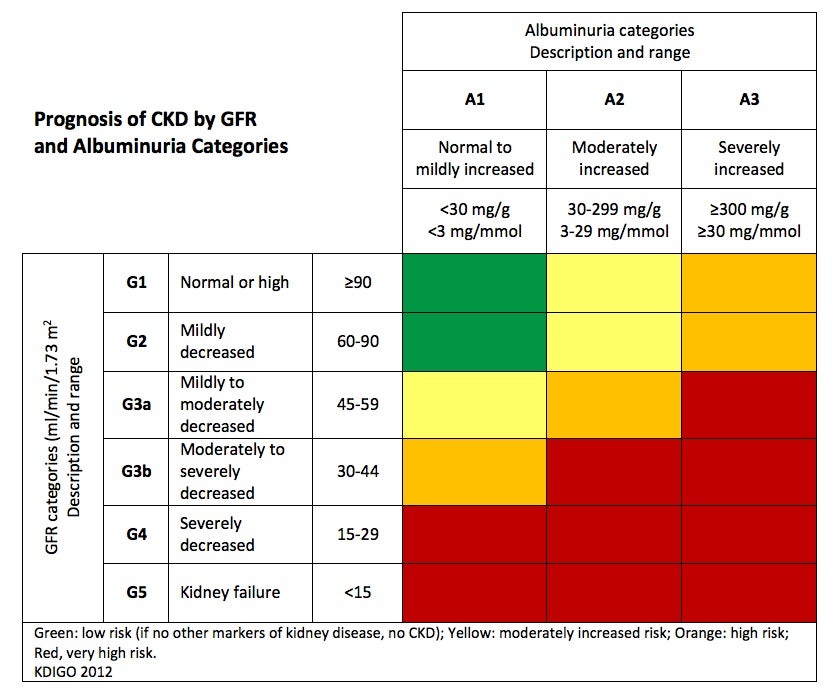
CKD Staging is also based on the level of proteinuria seen in the patient. If there is proteinuria or greater than 300mg albumin/mg/g Cr in a urine protein:creatinine ratio, then the proteinuria is staged as A3. If between 30-300 (microalbuminuria), the staging is A2. A1 is if there is no significant proteinuria or microalbuminuria.

Prognosis
The eGFR and proteinuria offers a general prognosis as demonstrated in the Heat Map.


With an estimated GFR and knowledge of proteinuria, the risk of kidney failure requiring dialysis or transplant can be calculated using a Kidney Failure Risk calculator based on Tangri et al, JAMA 2016. More generally, a lower eGFR has an observed association with the risk of death, cardiovascular events, and hospitalization.


Initial Work-up
Recommended workup for new diagnosis of CKD:
●      Serum electrolytes for eGFR and electrolyte abnormalities (e.g. metabolic acidosis)
●      Complete Blood Cell Count (Anemia)
●      Lipid profile
●      Uric Acid
●      Serum albumin
●      Renal ultrasound
○      to look for hydronephrosis, obstruction, cysts, stones, and assess kidney size and characterization
●      Urinalysis
○      Quantify proteinuria with urine protein-to-creatinine ratio (Urine albumin-to-creatinine will miss multiple myeloma Bence-Jones proteins)
○      Look for hematuria or other signs of glomerulonephritis
●      Consider biopsy if significant proteinuria and no history of diabetes

In patients with CKD G3 (eGFR less than 60 mL.min):
●      Serum calcium, phosphorus, PTH, Vitamin D to assess for Bone Mineral Disease

If suggested by the history and physical examination and UA:
●      Antinuclear antibody testing to evaluate for lupus
●      Hepatitis B and C, and HIV serology
●      Serum antineutrophil cytoplasmic antibodies to evaluate for ANCA-associated vasculitis
●      Serum and urine protein immunoelectrophoresis to test for multiple myeloma


Monitoring
All patients with at least CKD G4 disease (GFR ≤30 mL/min/1.73 m2 ) should establish care with a nephrologist. Consultation is also recommended if proteinuria greater than 3g / 24 hr, evidence of glomerulonephritis (hematuria, proteinuria, and hypertension), an eGFR decline of 50% within 1 year.

General management should also prioritize treatment of the underlying condition (e.g. hypertension and diabetes) to reverse the progression of CKD.

Management
Medications
ACE-inhibitors demonstrate a significant reduction in progression of CKD and reduction in proteinuria per the RENAAL, IDNT, and other trials. Fewer patients had progression to ESKD though a mortality benefit was not observed.

Of note, ACE-inhibitors or ARBs (RAAS blockade) are likely to cause a benign increase in serum creatinine. In general, if the creatinine bump greater than 30%, RAAS blockade should be discontinued. An increase in creatinine after ACE-I may show greatest risk of mortality (though it is unclear what would happen if the patients with bumps were not on ACE-I, so this is not an indication to necessarily discontinue therapy).

Blood Pressure Treatment
Per KDOQI 2012 guidelines, target blood pressure in CKD is less than 130 over 80 mm Hg. With<130 mmhg.="" span="" style="mso-spacerun: yes;"> <130 mmhg.="" nbsp="" span="">ACE-inhibitors being the first line drug.

Diabetes Control
Metformin: if eGFR 30-45 and already on metformin (and this is not AKI) can continue metformin. Do not start NEW if eGFR is 30-45, but ok if higher than 45.  

SGLT2 inhibitors (i.e. Empagliflozin and Canagliflozin) are associated with lower rates of worsening nephropathy, progression to macroalbuminuria, initiation of renal replacement therapy and mortality. (EMPA-Reg, EMPA-Reg ESRD + CANVAS). However, studies demonstrating their effectiveness in CKD are ongoing.

Bone Mineral Disease Screening
All patients with CKD G4 should be screened for secondary and tertiary hyperparathyroidism. The screening labs are a PTH, phosphorus, calcium and vitamin D level. Further information can be found at the KDIGO guidelines on BMD.

Depression Screening
Depression in CKD patients affects approximately 20% of all CKD patients.

Anemia
There are multiple causes of anemia in patients with CKD including iron deficiency. KDIGO recommends intravenous iron for anemic, nondialysis, CKD patients with transferrin saturation
<30 and="" ferritin="" isual="" span="" summary="">here).

Nutrition
Guidelines remain controversial but a full discussion can be found at the AKJD Blog or in the recent NEJM Review.

Medications to Avoid
Bactrim
Use of Bactrim (trimethoprim-sulfamethoxazole) was associated with 3 excess cardiac deaths per 1,000 prescriptions presumably due to hyperkalemia (e.g.  patients with CKD are higher risk)

Baclofen- should be avoided in ESKD or eGFR less than 30 and dose reduced with eGFR between 30-6o.<30 .="" 30-60="" adjustment.="" dose="" font="" requires="">

Proton Pump Inhibtors
Observational data demonstrates a link between proton pump inhibitors and CKD.

Renally dosed medications
Certain medications, such as gabapentin, also will require renal adjustment for dosing.

Contrast?
Contrast-induced kidney injury (CIN) may be overestimated in literature. The AMACING trial shows that pre-hydration does not reduce kidney injury in those exposed to contrast.

NSAIDS?
Patients with CKD depend on prostaglandins for vasodilation of afferent arterioles and renal blood flow. NSAIDs block prostaglandin activity and can cause acute kidney injury.  KDIGO Guidelines recommend avoiding NSAIDS in patients with CKD, but the evidence suggests that risk of NSAID use in CKD patients is pretty low: The Male Physician Study showed no elevation in serum creatinine with consistent NSAID use. However, the PRECISION Trial showed only ~1% risk of kidney events in CKD patients with daily high-dose NSAIDs.

For a more succinct review of the above, check out the new ClinicWiki page on Chronic Kidney Disease.

Post written by
Justin Berk, MD, MPH  @justinberk
Med-Peds Resident, John Hopkins University
NSMC Intern 2018