Showing posts with label CVVH. Show all posts

Tuesday, October 1, 2013

CKD after AKI in the ICU

I give a regular talk to the residents in the ICU on CRRT and one of the things that I focus on is prognosis. We all know that the outcomes of patients requiring CRRT in the ICU are poor. Multiple studies have shown that the mortality is 40-60% and that this mortality rate has not changed in the last 20 years. However, something that residents are less aware of is that, in the event that a patient survives their stay in the ICU, the majority will not require long term dialysis - approximately 80%. This is sometimes difficult to appreciate when you see patients on HD at discharge from the ICU but most of these will recover at least some renal function. One question, however, is how much function they recover and if this has any bearing on their overall mortality.

A paper recently published in CJASN goes a long way towards answering these questions. This was a retrospective cohort study of all 1220 patients admitted to the ICU requiring CRRT in a single center in the Netherlands between 1994 and 2010. As expected, the in-hospital mortality was high (55%). Of those who survived, 12% did not recover enough renal function to come off dialysis after discharge.

The commonest reasons for admission were thoracic surgery and sepsis. 20% of patients had pre-existing CKD, 48% had normal baseline renal function. There was no baseline in the remainder. At the time of discharge from hospital, 60% of patients had some degree of renal dysfunction (30% eGFR 30-60, 15% eGFR 15-30, 15% eGFR 0-15 including the 12% on HD). Of note, more than half of the patients with an eGFR <15 at discharge had pre-existing CKD. Unadjusted patient and renal survival is shown in the table:
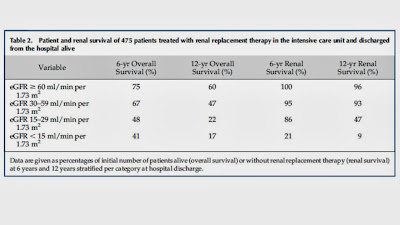

The independent predictors of long term mortality were age, a surgical diagnosis, malignancy and an eGFR < 30. Similarly, the predictors of future need for dialysis were pre-existing CKD, and an eGFR < 30 at discharge. Interestingly, an eGFR between 30 and 60 was not associated with an increased risk of mortality or need for RRT in the future, relative to those with normal renal function at discharge.

This study adds to our knowledge of the predictors of outcomes after an episode of AKI requiring CRRT. No-one should be surprised that patients with significantly reduced GFR at discharge at are increased risk of mortality and need for eventual dialysis. However, it is reassuring that, in those patients who have an eGFR >60 at discharge, the likelihood of them requiring dialysis in the future is very low. It would be interesting to know if the presence of proteinuria modified the relationship between eGFR and mortality/need for dialysis, particularly in those with an eGFR between 30 and 60 at discharge but unfortunately, these data were not available.

Friday, June 15, 2012

Gassy


When putting a patient on CRRT, the choice of buffer these days is largely dependent on whether or not you want to use citrate for anticoagulation. Most of our patients get either citrate or bicarbonate. However, not so long ago, the main buffer was lactate. When bicarbonate was first being used as a buffer for CRRT, it had to be added separately to each bag and, in our institution at least, it came in a glass bottle next to the CVVH fluid.

More recently, the bicarbonate comes in a separate compartment of the same replacement fluid bag and just prior to use, a valve is broken and the bicarbonate-rich fluid is mixed with the rest. I had previously assumed that this was because you do not want to mix bicarbonate with calcium because of the risk of precipitation. However, in our institution, we currently use calcium-free replacement fluid and so there is no risk of precipitation (the calcium is given intravenously to the patient based on a sliding scale).

It turns out that the reason for the separate bicarbonate bags is much more interesting. Most i.v. fluid bags are gas permeable. Therefore, if you leave bicarbonate in the bag for a prolonged period of time, CO2 will leach out of the bags. By a passive process, the bicarbonate in the fluid will then be converted to CO2 which will come out of solution and will in turn leach. You will, in the end be left with very little bicarbonate in the bags. To get around this, the manufacturers of dialysate fluids used put the bicarbonate in a separate glass bottle, This is expensive and cumbersome and is prone to errors if somebody forgets to add it to the solution. Instead, now the bicarbonate-containing dialysate fluids are double-bagged. The inner bag contains the solution and is gas-permeable as before. The outer bag is constructed of a thicker, non-permeable plastic that keeps the CO2 inside. Also, to reduce diffusion further, the air between the two bags has a relatively high CO2 concentration. 

Monday, June 11, 2012

Mercury rising

A patient who had been working in a recycling company that handled thermometers presented with fever, dry cough, fatigue and rash. Based on imaging (CXR showed massive radio-opaque material in the lungs, right atrium and right ventricle; skeletal survey showed radio-opaque deposits in the kidneys, bowel wall, and bladder wall), symptoms, and a positive history of exposure, a diagnosis of mercury intoxication was made. The patient developed multi-organ failure including anuric acute renal failure, and nephrology was consulted. Further background details on the case can be found here. What is the treatment and the role of dialysis in mercury intoxication? 


Metallic mercury has a widespread use both within industry and in many everyday objects such as thermometers, dental amalgams, batteries, fluorescent light bulbs, and many others. Mercury intoxication can result from vapor inhalation, resulting in severe respiratory symptoms, or from injection, usually in cases of attempted suicide. 


The chelating agents 2,3- dimercaptopropanesulfonic acid (DMPS) and meso-2,3-dimercaptosuccinic acid (DMSA) are central to the management of mercury toxicity. DMSA is given orally, and can cause leucopenia and elevated liver enzymes. DMPS is an intravenous medication and its use is associated with hypotension. In our patient, DMSA 500 mg po q 8hrs was given for 4 days, before it was discontinued because of elevated LFTs and leucopenia. We then started DMPS with CRRT but unfortunately, after two weeks of supportive treatment, the patient died. 


Chelators such as DMPS and DMSA work by mobilizing mercury and facilitating its excretion through the kidneys. This creates a management conundrum in the anuric patient, as this route of excretion is not available. Consistent with this, our patient’s blood mercury levels rose dramatically during chelator treatment, despite CRRT. We hypothesize that the administration of DMPS mobilized mercury from extracellular deposits and redistributed it to the blood and organs, but it failed to be adequately eliminated from the body because of anuria. For this reason, intensive CRRT with a high-flux dialyzer is a critical adjunct to chelator therapy. If this is not available, continuous renal replacement therapy with chelators have showed better mercury clearance than conventional dialysis, whereas peritoneal dialysis has been shown to be ineffective at clearing mercury. These principles should be borne in mind in other heavy metal poisonings also. Other management pearls I took from this unusual case were to initiate dialysis early and to give DMSA at a lower and more frequent dose to avoid serious side effects. 


Tarek Alhamad M.D.

Tuesday, April 5, 2011

Sepsis & AKI - an insoluble problem?


I expect very few medical users of this website went into nephrology to manage acute kidney injury (AKI) in the context of sepsis. It is hard to avoid pessimism when considering the state of play in this condition: 65% of patients with septic shock develop AKI; this AKI is an independent risk factor for death and up to 75% of patients with AKI and severe sepsis die.

It is, therefore, not surprising that research into this area continues. Much of which has focussed on the use of extra-corporeal blood purification techniques (EBP) to improve outcomes via immune modulation by removal of circulating inflammatory mediators (summarised in this recent review by Ricci et al.).

The most familiar EBP technique is standard CVVH delivered at high doses. Indeed, when I was training in ICU in 2008 we would regularly use high volume CVVH (often seeking treatments of up to 6 L/hr) in patients with co-existent severe sepsis and AKI. Although both the ATN and RENAL trials failed to demonstrate any benefit of this tactic in the management of severe AKI, many feel that the ‘high intensity’ groups in these trials were simply not high intensity enough to demonstrate a treatment effect in septic patients. This feeling largely stems from a favourable body of evidence (summarised in this review) from animal studies and small trials with soft end-points using CVVH doses of 45-115ml/kg/hr (in contrast to the ATN and RENAL CVVH doses of 35-40ml/kg/hr). The completed but unpublished IVOIRE trial prospectively randomised 139 patients with septic shock and AKI to 70ml/kg/hr or 35ml/kg/hr with a primary outcome of all-cause mortality and may help to settle this argument.

The counter view is that dose approaches are bound to fail because whilst inflammatory mediators are water-soluble, their molecular weight means that they are unlikely to be maximally cleared by standard haemofilters. This can be attacked in two ways: high-cut off membranes or haemadsorption.

High-cut off membranes have been evaluated in small studies and demonstrated reduction in vasopressor requirements in septic patients. However, when used in continuous treatments these filters are associated with a very large obligate loss of albumin, leading some to suggest such filters should only be used in intermittent treatments (i.e. dialysis; similar to strategies used in myeloma).

Haemadsorption passes blood across broadly interacting sorbents to attract larger molecules, which exceed the cut off of standard membranes, thus making this an attractive technique for EBP in sepsis. Use of this technology had previously been limited by poor biocompatibility and resultant haematological abnormalities but recent advances have eliminated this problem. The commonest sorbent is polymyxin B, a systemically toxic antibiotic which can bind lipopolysaccharide and damage gram-negative bacteria. Although a number of studies have evaluated polymyxin B haemadsorption significant further work is required to make a compelling case for this treatment (excellently summarised by Ricci et al.)

Furthermore, coupled plasma filtration and adsorption has been trialled. This allows initial separation of plasma from blood, followed by selective passage of the plasma across the sorbent and has demonstrated some efficacy in small initial studies.

I find it hard to see where this field is going to end up; only high volume haemofiltration strategies seem to have a consensus behind them and these will always now be open to the charge that randomised controlled trials have shown them to be ineffective. Adsorptive techniques are currently relatively heterogeneous and therefore, the large multicentre trials required to demonstrate their applicability seem a long way off. It appears that septic AKI may continue to be a feared condition for some time yet.

Thursday, March 31, 2011

Argatroban

Critically ill patients receiving continuous renal replacement therapy are frequently given heparin to maintain circuit patency. In the presence of active HIT-II or HITT, even in the absence of clinical thrombosis, systemic anticoagulation with a direct thrombin inhibitor (DTI) decreases the incidence of thrombotic complications, if given until thrombocytopenia has resolved. In this scenario, anticoagulation to maintain CRRT circuit patency is a bonus. In critically ill patients requiring CRRT with a history of HIT-II, but not active thrombocytopenia or thrombosis, avoidance of heparin exposure is still recommended, and argatroban is currently a common choice of DTI if systemic anticoagulation is required. As this is a drug that nephrologists need to be very familiar with, here's a list of essential facts about argatroban in the form of a mnemonic, for those of you who get off on that kind of thing.


A nticoagulant of choice in active HIT-II or HITT.
R enal dose adjustment not necessary – hepatically cleared only.
G oal aPTT is 2-3 times above baseline (as for heparin).
A ctivated PTT is monitoring test of choice, but note argatroban increases ACT and PT/INR also.
T wo mcg per kg per minute is the usual starting dose (2mcg/kg/min)
R eversal not possible, so careful monitoring essential.
O .5 mcg/kg/min starting dose in liver disease (0.5mcg/kg/min)
B olus not required before infusion (unlike heparin). Steady state within 3 hours.
A lbumin: Low albumin is an important clue to hepatic synthetic dysfunction. Reduce starting dose by 75% if present.
N ormalised ratio: When transitioning to warfarin, once the INR is 4 while on both drugs, the INR will be therapeutic once the argatroban infusion is stopped. The alternative is the measure the chromogenic factor x level (goal less than 45% for efficacy).

Friday, August 21, 2009

pre-dilutional versus post-dilutional CVVH

There are two general strategies for CVVH replacement solution entering into the blood circuit: pre-dilution (in which replacement solution is mixed with the blood prior to its entry into the filter), or post-dilution (in which replacement solution is mixed with the blood after it has passed through the filter). Each method has its own advantages and disadvantages. Where I have trained, we always use the pre-dilution method. The theoretical advantage here is that because the blood is diluted prior to entry into the filter, there is a lower risk of clotting the filter, allowing for longer filter life and reduced down-time for the CVVH machine. We often claim that CVVH is a continuous therapy, but due to technical issues it is not uncommon for the therapy to be halted for several hours out of a day; pre-dilution technique may help minimize this. Furthermore, pre-dilution allows for near-limitless ultrafiltration rates, essential when rapid volume removal is necessary. The main cited drawback of the pre-dilution method is that much of the fluid passing through the filter is actually replacement fluid--thereby leading to a reduced efficiency of about 10-15% in clearance when compared to tost post-dilutional method, in which all the fluid moving through the filter is the patient's. Generally this is not a problem given that this is a near-continuous therapy, but proponents of the post-dilution method claim improved efficiency as an advantage. It is important to specify pre- versus post- dilution methods in the interpretation of various publications in CVVH.

Tuesday, July 15, 2008

Troubleshooting CVVH

Even though most studies have not shown any mortality benefit to CVVH when compared to intermittent hemodialysis, that doesn't mean that we don't use CVVH all the time. At our centers (Mass General Hospital and Brigham & Women's Hospital) CVVH is really the preferred modality for patients in the ICU with any hint of hemodynamic instability. Here are the major complications unique to CVVH to be aware of (taken from a recent David Steele lecture I just heard):

1. Citrate Toxicity. For patients in whom a citrate-based replacement solution is used, citrate toxicity may develop in patients with liver disease who lack the ability to convert citrate to bicarbonate. As a result, citrate accumulates and results in a worsening anion gap metabolic acidosis. The increasing citrate levels bind ionized calcium (reducing the iCa level), and the acidosis causes a dissociation of calcium and citrate in vitro, resulting in a rising total Ca level. Patients with citrate toxicity must be converted to a bicarbonate-based replacement solution ASAP.

2. Refractory Acidosis. Occasionally patients who are very hemodynamically stable will remain acidotic even while on CVVH. One solution to this dilemma is to increase the replacement solution rate. For example, at a standard RS rate of 1600 cc/hr, this is delivering a HCO3 concentration of 64meq/hour; increasing the RS rate to 2400 cc/hr will therefore increase the HCO3 delivery rate to 96meq/hour. Another strategy is to add an isotonic NaHCO3 drip: at 250 cc/hour, this results in an additional 37.5 meq/hour, and the additional volume can be handled by ultrafiltration.

3. Electrolytes: Phosphorus and Potassium often need repletion due to the continual nature of CVVH.

4. Recurrent System Clotting: The bane of the Nephrology Fellow is recurrent system clotting, as it may lead to repeated late-night phone calls and unplanned dialysis catheter placements. There are several maneuvers one can perform to limit clotting, though none has a 100% success rate. These include changing to a citrate-based replacement solution, using systemic anticoagulation (e.g., heparin or Argatroban) if it is not contraindicated, increasing the blood flow rate, increasing the replacement solution rate, or performing a heparin prime & dump before beginning. If all else fails, a new dialysis catheter (preferably something with a wide lumen, such as a Niagra catheter) may be warranted.

Saturday, June 14, 2008

CVVH Basics

CVVH (continuous venovenous hemodialysis) is the form of CRRT (continuous renal replacement therapy) used in our hospital. Although most studies have not shown a mortality benefit in patients treated with intermittent hemodialysis versus those treated with CVVH, in my opinion there is a subset of patients--I'm talking the sickest of the sick, often patients on multiple pressors, sometimes those who are s/p major cardiac surgery on balloon pumps and/or ventricular assist devices--who require CVVH in order to achieve adequate volume removal.

At our hospital, there are two main types of CVVH replacement solution that we use: bicarbonate-based and citrate-based. Both provide adequate base, as citrate is metabolized to bicarbonate in the liver. Citrate provides superior anticoagulation to bicarbonate alone; it's also advantageous in that it provides extracorporeal anticoagulation while avoiding systemic anticoagulation, as the Ca gluconate drip which is administered simultaneously to the blood as it re-enters the body binds to and neutralizes the citrate. Bicarbonate can be given with heparin but obviously this comes with some cost of internal bleeding. If a patient is already on heparin for something (e.g. MI, valve replacement) I would generally choose bicarbonate. Citrate-based replacement solution should be avoided in patients with severe liver failure or an anion gap metabolic acidosis; these problems predispose to citrate toxicity, which is reflected as an elevated total calcium but a decreased ionized calcium with a subsequent anion gap.

Tuesday, May 20, 2008

ATN Study: More Is Not Better

The results from the Acute Renal Failure Trial Network ("ATN Study") are revealed in the most recent issue of the New England Journal of Medicine.

The study was a randomized control trial in which ICU patients with acute kidney injury were randomly selected to receive either standard-dosed dialysis (defined as three times a week hemodialysis or CVVH at 20 cc/kg/hr) or more intensively-dosed dialysis (defined as six times a week hemodialysis or CVVH at 35 cc/kg/hr). The trial was not, as some people erroneously believe, intended to settle the contentious issues of whether there is any benefit of CVVH over intermittent hemodialysis; patients were actually permitted to move back and forth between intermittent hemodialysis and CVVH provided they stayed within the intensive versus the standard group to which they were originally assigned.
.
The results: no significant difference was found in the standard compared to the intensively-dosed groups. The study is somewhat at odds to the famous Ronco study published in 2000 in the Lancet which demonstrated a survival benefit in patients who received a higher dose of CVVH (either 35 or 45 cc/kg/hr) compared to those receiving a lower dose (25cc/kg/hr).