Showing posts with label uric acid. Show all posts

Tuesday, February 21, 2017

Spontaneous Tumor Lysis Syndrome

A 70 year old Ghanaian man was recently admitted under our care.  He had been diagnosed with aggressive myelodysplasia 2 months previously after presenting with fatigue and abnormal blood results (WBC 50.3, platelets 130 and LDH 928 at the time of diagnosis).  A plan was made for palliative chemotherapy. One month after his diagnosis he developed a large pericardial effusion and had 1L of haemorrhagic fluid drained.  At this point his creatinine was 200 umol/L (2.26 mg/dL).  Routine and TB culture of the fluid was negative, as was cytology and immunophenotyping.
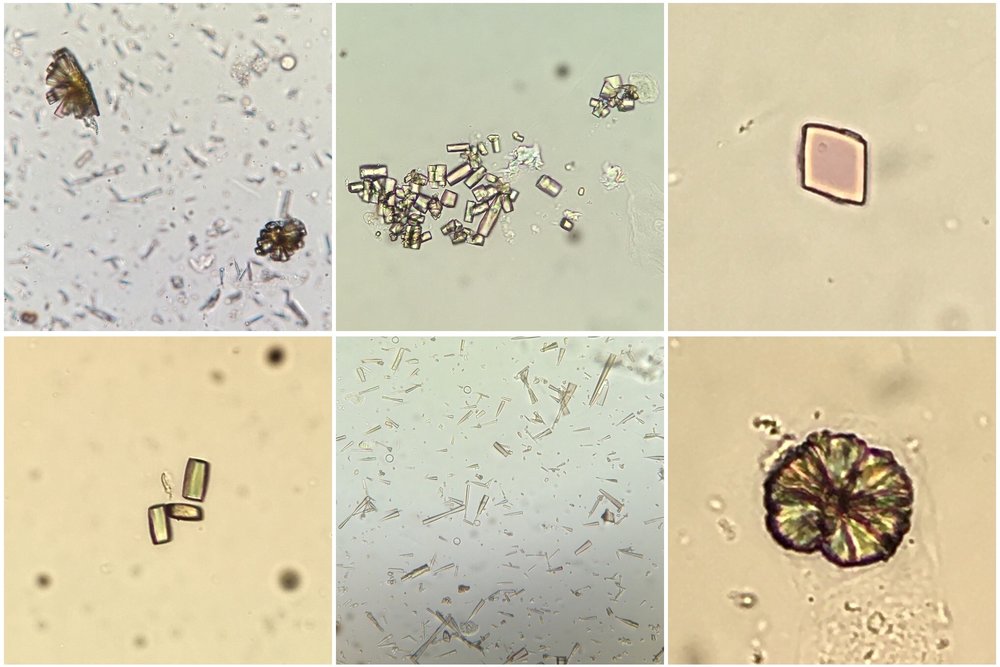
Image result for swissnephro uric acid
Two weeks after this admission he represented with abdominal pain.  A CT showed bilateral renal and bladder calculi without obstruction.  He was oliguric with a creatinine of 577 umol/L (6.5 mg/dL) rising to 709 umol/L (8 mg/dL) over the next 12 hours.  His uric acid level was 18.0 mg/dL, which had not been checked previously.  Phosphate was 1.86 mmol/L (5.75 mg/dL), Ca 2.1 mmol/L (8.4 mg/dL) and K 4.6 mmol/L.
Our diagnosis was of a spontaneous tumour lysis syndrome (TLS; see previous RFN posts here & here).  Nucleic acids released from tumour cell lysis are broken down into xanthine and then uric acid by xanthine oxidase.  Renal failure is caused by uric acid precipitating in renal tubules causing a mechanical obstruction and inflammatory reaction.  While TLS is typically seen following initiation of chemotherapy causing a rapid breakdown of cancer cells, a spontaneous form has been described in acute leukaemia and NHL.  Our patient was at high risk of converting into AML but had no rise in peripheral blasts to suggest this.
Interestingly, spontaneous tumour lysis syndrome is associated with hyperuricemia but often without the hyperphosphatemia (and hyperkalemia) seen in the classical form of the disease– thought to be because the released phosphorus is quickly used up in the generation of new tumour cells.  This would fit with our patients results.
Our patient was commenced on dialysis which gave reductions in uric acid levels of 50% per treatment, but they quickly rebounded.  He was no longer fit for treatment of his myelodysplasia making longer term management more difficult.  Given his African ethnicity, we checked his glucose-6-phosphatase levels, which were normal, before he received rasburicase (recombinant urate oxidase). Rasburicase reduces uric acid levels by converting it into allantoin.  It may cause severe oxidative hemolysis if glucose-6-phosphatase deficient. Uric acid fell to undetectable levels following this however he had an ongoing dialysis requirement (note that rasburicase retains in vitro activity in the blood bottle so sample should ideally go on ice).  Allopurinol as a longer term medication to reduce uric acid formation may be useful, but may not manage to suppress formation sufficiently.  
In addition to tumour lysis syndrome, acute urate nephropathy can be caused by other states of tissue catabolism such as seizures, in primary overproduction of uric acid or in cases of reduced urate reabsorption in the proximal tubule. Urinalysis can show uric acid crystals (birefringent with polarisation; see image) or can be normal (as in our patient) perhaps due to a lack of output from obstructed tubules. 
This case raised several points to me. Was his pericardial effusion also caused by a urate infiltration?  No clear cause was ever identified at the time and he did not appear ‘uremic’ despite his renal dysfunction.  Could any of this have been prevented if treatment for his hyperuricemia had been commenced earlier?  I also learned:
  • The nuances of spontaneous tumor lysis syndrome (often phosphate & K not hugely elevated).
  • Rasburicase is contraindicated if glucose-6-phosphatase deficient (approximately 20% of Africans).
  • The ‘undetectable’ result of urate after rasburicase administration appears to be due to in vitro activity of the drug in the blood bottle.

Image thanks to Florian Buchkremer @swissnephro

Post by Ailish Nimmo

Sunday, December 6, 2015

Targeting Uric Acid in CKD

In our search for therapies to reduce CKD progression, hyperuricemia has historically not been a major target despite being a potential risk factor for progression. Two recent studies however, raise the possibility that treating hyperuricemia could slow progression.


Should hyperuricemia be a treatment target? 


Hyperuricemia is associated with hypertension, cardiovascular disease, the metabolic syndrome, inflammation, and oxidative stress. The role of uric acid as a risk factor for incident CKD or CKD progression is more controversial. However, there are studies that suggest a pathophysiologic role for hyperuricemia. For example, in a study of over 20,000 healthy Austrians, serum levels of 7-8.9 mg/dl and ≥ 9 mg/dl were associated with odds ratios for CKD of 1.74 and 3.12 respectively. This was after adjusting for renal function, metabolic syndrome, and blood pressure agents, which are all independently associated with hyperuricemia. More recently, hyperuricemia was also associated with incident CKD in patients with type 2 diabetes. However, not all studies have shown that hyperuricemia worsens renal disease. For example, an analysis of the MDRD study, identified hyperuricemia as a risk factor for cardiovascular mortality but not renal failure.

Uric acid’s effect on inflammation, oxidative stress, and endothelial dysfunction certainly could worsen renal function. Hyperuricemia activates RAS and contributes to systemic and glomerular hypertension in animal models. Hyperuricemic animal models are associated with vascular damage and tubulointerstitial fibrosis, which can be alleviated by reducing uric acid levels pharmacologically. More information on the pathophysiology of uric acid in CKD can be reviewed here.

This year, two small studies evaluated the prospect of treating hyperuricemia to reduce CKD progression. Joel's Dream RCT coming to life.

Study 1:
Goicoechea et al published in AJKD a follow-up to their earlier trial from Spain evaluating the use of allopurinol. The original trial was a 2-year study of allopurinol, 100 mg/d, vs. placebo in 113 subjects. This recent paper described a subsequent 5-year follow-up study with 107 subjects. In their intention to treat analysis, allopurinol appeared to reduce the risk of renal events (needing dialysis or doubling of Cr) and cardiovascular events by about ½. Notably, during the follow-up period, approximately 20% of the intervention group patients stopped allopurinol while a similar percentage in the control group started allopurinol.

Study 2:
This study, again reported in AJKD performed in India, is a 6-month RCT trial of febuxostat (40 mg) vs. placebo in 93 patients. As expected, febuxostat reduced uric acid levels effectively (9 --> 5.2 mg/dL vs. 8.2 --> 7.8 mg/dL in controls). However, febuxostat also reduced the primary outcome of GFR decline with fewer patients having ≥ 10% decline in eGFR from baseline (38% vs. 54%, p 0.004).


So where does this leave us? 


These rather small studies, based primarily on surrogate outcomes, show that there may be a possible benefit to treating hyperuricemia, but this is far from definite. Two meta-analyses (one and two), both published prior to the recent febuxostat study, suggest that urate lowering therapy may reduce CKD progression. However, they mostly highlight the overall poor quality of evidence addressing this subject. Unfortunately, at this time there are no further trials registered on clinicaltrials.gov.

In the end, perhaps for the very concerned patient who is meeting all the other well defined goals to reduce CKD progression, hyperuricemia should be controlled to reduce CKD progression. Though clearly the data is far from conclusive.

On a related note, an international research group recently published an article about the role of uric acid damage in Mesoamerican nephropathy which is well worth reading (AJKD, “Heat stress nephropathy from exercise induced uric acid crystalluria: a perspective on Mesoamerican nephropathy”). Finally, one might wonder why humans and apes developed hyperuricemia compared to the majority of mammals. As noted here (Goh, RFN blog), hyperuricemia may have provided our ancestors with an evolutionary advantage by maintaining blood pressure in a sodium poor environment.

Robert Rope, Nephrology Fellow, Stanford

Update-  Swapnil Hiremath pointed out the ongoing CKD-FIX study (Scroll to bottom of page) in Australia and New Zealand. The group is also on Twitter- follow them @kidney_trials

"The primary aim of the study is to test the hypothesis that uric acid lowering therapy with the xanthine oxidase (XO) inhibitor, allopurinol, will significantly slow kidney failure progression in patients with moderate chronic kidney disease (CKD). 620 adult participants with CKD stages 3 or 4 who have experienced rapid progression of their CKD over the preceding 12 months will be recruited to the trial. Participants will be randomised 1:1 to receive 100-300 mg of allopurinol daily (dose dependent on CKD stage and tolerance), and treatment will be blinded to participant and treating team. The primary outcome measure will be an assessment of eGFR throughout and at the end of the 24 month treatment period as a marker of CKD progression, and a series of secondary outcomes related to blood pressure, proteinuria, cardiovascular events and death will also be measured."

Sunday, March 23, 2014

NephMadness 2014 Part 6 - Kidney Stone Bracket

In the kidney stone bracket I think the most disappointed team must be XO inhibitors. Allopurinol has been around for a long time and is one of the mainstays of treatment for gout. More recently, febuxostat hit the scene and can also lower uric acid. The most interesting issue relating to uric acid (for me) is the evidence linking elevated uric acid with risk of developing CKD. This idea is backed by experiments in rats. Raising the uric acid level in rats can induce glomerular hypertension and renal disease as noted by the development of arteriolosclerosis, glomerular injury and tubulointerstitial fibrosis. Some pilot studies in human suggest that lowering uric acid levels can slow the progression of renal disease. If these findings are significant large RCTs, the old man Allopurinol and the young pup febuxostat would be catapulted into the stratosphere! A good review of this literature is found here. Despite these interesting findings, CT scan beat XO inhibitors for me. I think CT scanning, for good or for bad, is ubiquitous in medicine and won by shear prevalence! Another very interesting match up and some learning for me was the Dr Pak vs Dr Coe match-up, two heavy weights of renal stone disease. I vaguely remember learning about Randall’s plaques and supersaturation of urine years ago. The loser of this match up must surely be disappointed!

Wednesday, September 26, 2012

The Good the Bad and the Ugly - Uric Acid and the Kidney

At some point during evolution humans lost the enzyme uricase and during the long and tedious process of getting to the modern age and this was initially a good thing. Uric acid accumulation as a result of uricase loss is thought to have been protective in situations of hypotension in low salt environments, conferred increased intelligence and reduced oxidant stress (although some authors consider this highly speculative). The Nephrologist often has a role in managing gout, since uric acid is mainly excreted by the kidney.

So now that we do not have a shortage of salt anymore and our diet is rich in purines we get to see the drawbacks of evolution. This comes in the unpleasant form of gout. Most of the time, gout is caused by under-excretion of uric acid by the kidney and only in the minority of cases (~10%) by overproduction. Renal uric acid handling is complicated and about a decade ago a transporter with specific apical urate-anion exchange activity was described.

Gout can be triggered by a number of gluttonous habits:
  • Alcohol - causes increased urate synthesis and increased lactate production which increases urate reabsorption
  • Foods high in purines increase uric acid levels.
  • Lead causes increased uric acid levels by impairing urate excretion, which is associated with the development of gout (termed “saturnine gout”). This was much more common in older days when lead ingestion was high.
  • Dietary fructose acutely raises serum uric acid levels.
Therefore gout was considered a "true nobleman's disease" in earlier centuries and artists such as William Hogart used to portray them in their works.

Now some people are worse off because they have to take medications that cause hyperuricemia. Amongst them are transplant patients depending on immunosuppressants and diuretics, for example a heart transplant patient whom I recently saw in clinic.

Cyclosporine: Decreased GFR and possibly tubular damage contribute to cyclosporine induced uric acid retention. Tacrolimus does not offer any advantage over cyclosporine. A study in children with transplants concluded that cyclosporine induced tubular reabsorption of uric acid.

Diuretics:HCTZ is a common trigger of gout attacks but all other diuretics also do. Rising serum uric acid with diuretic use occurs with low doses and increases dose-dependently. Volume depletion stimulates a marked increase in proximal tubular reabsorption of urate. The mechanisms involved in the regulation of urate reabsorption by extracellular volume status are however unclear. Furosemide can induce hyperlacticacidemia sufficient to suppress tubular excretion of urate. Diuretics have also been shown to interfere directly with uric acid handling by the kidney. Loop diuretics and thiazides have been shown to directly inhibit NPT4-mediated urate secretion and furosemide can inhibit urate uptake by URAT1.

Management is aimed at lowering serum uric acid levels with Allopurinol or Febuxostat. Febuxostat is an alternative to allopurinol in patients with allopurinol intolerance or hypersensitivity.  In my (limited) experience uricosuric drugs such as Probenecid are rarely used in practice anymore and the teaching is that they actually can trigger acute gout attacks by initially decreasing excretion. Pegloticase, a pegylated recombinant porcine-like uricase, can be given in severe cases when Allopurinol or Febuxostat are not effective. The drug needs to be given IV but thanks to its long half-life only every 2-4 weeks.

Posted by Florian Toegel

Monday, January 4, 2010

Familial juvenile hyperuricemic nephropathy

I recently saw my first patient formally diagnosed with familial juvenile hyperuricemic nephropathy (FJHN), and since I had little prior knowledge about this condition, I decided to read up. Apparently, FJHN is more common than we think, and questions relating to FJHN do show up on renal boards.

Originally described by Duncan and Dixon in 1960, FJHN is an autosomal dominant disease characterized by
hyperuricemia, gout, and progressive renal failure. It was only recently discovered that FJHN was caused by mutations in the UMOD gene encoding the protein uromodulin, an 85 kDa glycoprotein involved in renal stone formation, the modulation of immune responses, and urothelial cytoprotection. These mutations lead to reduced renal excretion of urate. In vitro animal models of the disease suggest that the mutant forms of uromodulin cause the protein to be retained in endoplasmic reticulum, which inhibits normal trafficking to and expression at the cell surface. Patients often present in early adulthood with hyperuricemia or gout and normal blood pressure. The fractional excretion of urate is generally low. Renal dysfunction in these patients develops between ages 15-40 and is progressive, usually leading to ESRD in 10-20 years. On biopsy, patients are found to have chronic interstitial nephritis as well as thickening and splitting of the tubular basement membrane.

The optimal treatment strategy for FJHN is not clear at this time. Treatment with allopurinol to prevent gout has been recommended, though it remains uncertain as to whether or not allopurinol offers any significant benefit to preventing progression of renal disease.

Monday, October 19, 2009

Differential diagnosis of hypouricemia

Hypouricemia is defined as a serum uric acid level less than 2mg/dL. Although it is generally considered benign, hypouricemia has been associated with several important conditions relevant to nephrologists, including acute kidney injury, uric acid nephrolithiasis, and SIADH as examples. Here's a brief differential diagnosis of hypouricemia, which can be broken down into two main categories: decreased uric acid synthesis, and decreased renal reabsorption of uric acid.

I. Decreased uric acid synthesis:

1. allopurinol effect: allopurinol is an inhibitor of xanthine oxidase, the rate-limiting step in the synthesis of uric acid. Thus, allopurinol is a common cause of hypouricemia, though rarely does it cause a complete loss of uric acid synthesis.

2. congenital hypouricemia: individuals with the autosomal recessive disease hereditary xanthinuria have mutations in the gene encoding xanthine oxidase and as a result accumulate the uric acid precursors xanthine, which is fairly insoluble. As a result, individuals with hereditary xanthinuria develop xanthine nephrolithiasis and myopathy due to xanthine deposits in muscle, and typically have a profoundly low serum uric acid level.

3. liver failure: as a majority of xanthine oxidase is synthesized in the liver, individuals with severe cirrhotic liver disease may have a low serum uric acid level.
II. Decreased renal uric acid reabsorption.

1. Fanconi's Syndrome/proximal tubule dysfunction: since a majority of renal uric acid reabsorption occurs in the proximal tubule, it makes sense that any type of proximal tubular dysfunction will lead to hypouricemia (along with a host of other metabolic abnormalities such as proteinuria, glucosuria, aminoaciduria, hyphosphatemia, etc.)

2. SIADH: a clinical pearl often helpful in the diagnosis of SIADH is that it is very often associated with a very low serum uric acid level, allowing one to distinguish SIADH from other causes of hyponatremia. One possible mechanism for this is that ADH stimulating V1 receptors reduces renal uric acid uptake; this is based on the observation that individuals with SIADH experience a more profound hypouricemia than patients treated with ddAVP (which should selectively stimulate the V2 receptor).

3. Drugs. Some drugs can induce hypouricemia, including probenicid (a direct inhibitor of the organic anion transporter which is responsible for the tubular reabsorption of uric acid) and Bactrim, for instance.

4. Familial Renal Hypouricemia: this is a rare congenital disorder (most common in non-Ashkenazi Jews and Japenese individuals) caused by loss-of-function mtuations in the organic anion exchanger; individuals can exhibit a fractional excretion of uric acid that is greater than 95% due to an inability to reabsorb uric acid. Not surprisingly, these individuals are at high risk for urate nephrolithiasis.

Sunday, April 19, 2009

Lesch-Nyhan Syndrome

I remember learning about Lesch-Nyhan and thinking it was fascinating early on during a college course on neurology & behavior: affected children with this X-linked disorder develop the bizarre but highly characteristic behavior of self-mutilation, intentional biting of the tongue and lips for instance. The neurologic basis for these behavioral changes is not entirely understood, but the underlying basis for the disorder has to do with uric acid metabolism: the affected gene in Lesch-Nyhan syndrome is the hypoxanthine-guanine phosphoribosyltransferase (HGPRT) gene, which is necessary for the salvage pathway of purine synthesis for DNA. The absence of HGPRT results in elevated levels of uric acid which result in uric acid nephrolithiasis, gout, and gouty nephropathy in addition to the disturbing CNS manifestations mentioned above. The gold standard for diagnosis is discovering low levels of HGPRT enzyme activity in cultured cells from the affected individual.

A recent article in AJKD describes the use of Rasburicase to treat elevated uric acid levels in Lesch-Nyhan syndrome in an affected neonate. Rasburicase is an urate oxidase enzyme which rapidly reduces serum uric acid levels; it will be interesting to see if this reduction translates into an improvement in neurologic symptoms seen in this syndrome.

Monday, May 5, 2008

Uric Acid & Hypertension

Keeping with our theme of uric acid from yesterday: Do elevated uric acid levels play a causative role in essential hypertension?
I just finished attending the Renal Grand Rounds at Beth Israel-Deaconess Hospital featuring Dr. Rick Johnson, a physician-scientist who makes a very compelling argument in favor of an etiologic role for uric acid in primary HTN.

As I see it, the strongest evidence supporting such a link includes:

1. In most large, epidemiologic studies, uric acid is a clear risk factor for developing hypertension; furthermore indigenous cultures with low uric acid levels (probably due to a non-Western diet) have low incidences of high blood pressure.

2. In some small observational studies involving pediatric patients with essential hypertension and uric acid levels > 6, treatment with allopurinol clearly decreased high blood pressure.

3. Making rats hyperuricemic induces hypertension due to a mechanism involving a direct endothelial toxic effect of uric acid.

There are certainly caveats to this hypothesis--for instance, rats aren't humans, epidemiologic evidence does not imply causation, and a large randomized controlled trial is really necessary before we should be using allopurinol as a blood pressure lowering agent. But it's an interesting story thus far and if it's true, it could really impact one of the most important public health problems which exists.

Sunday, May 4, 2008

Tumor Lysis Case

Interesting case from one of my calls last week (although I understandably would have been more enthusiastic about the case at the time had I been called about it 10 am rather than at 10 pm, prompting an overnight stay in the hospital by one unlucky Renal fellow).

A 65 year-old male with a history of acute lymphoblastic leukemia (ALL), completed chemotherapy about 3 weeks ago and thought to be in remission, went to his Oncologist's office for a routine checkup. He was found to have a WBC of 30 with 50% blasts and a Cr of 8. Also of note his K was 5.9, his uric acid was 22, and sadly he noted that he hadn't peed for 3 whole days (do you think you'd go see your doctor if you hadn't peed all day long? I think I would, but who knows). The diagnosis wasn't difficult: tumor lysis syndrome. The more interesting question was the management, and specifically, should he be dialyzed in the middle of the night or not?

On the pro-emergent dialysis side: He's got a K of 5.9 with some peaked T-waves, and in the absence of urine output it may be difficult to get down on its own. Also, since uric acid is dialyzable, one could argue that it may be possible to minimize renal damage by getting rid of the uric acid.

On the anti-emergent dialysis side: His K isn't all that high and we could try & get it down with kayexalate; we could give him Rasburicase (a recombinant urate oxidase medication) to acutely lower urate.

We did end up putting a dialysis catheter emergently and dialyzing him overnight, in addition to giving him a dose of Rasburicase. Within 48 hours his uric acid level was below the level of detection in our assay--I'm not sure whether the dialysis or the Rasburicase was more effective in acutely lowering serum urate. In any case, the patient received a total of 3 dialysis sessions, and fortunately has showed signs of making a complete renal recovery this weekend.

Bring on the chemo!