Showing posts with label #NephMadness. Show all posts

Monday, March 26, 2018

#NephMadness Living Kidney Donor Case Challenge #LKDCC #7 (Wrap-up)


Link to all of the #LKDCC cases here:

Case 1: Rajiv

Case 2: Hayley

Case 3: Barry

Case 4: Beatriz

Case 5: Ari

Case 6: Helen

Read more about the #NephMadness Transplantation Region at the AJKD Blog and submit your #NephMadness brackets here by Friday March 30!

Created by Kate Robson (Nephrologist, Melbourne, Australia and NSMC Intern 2018)

Saturday, March 24, 2018

#NephMadness Living Kidney Donor Case Challenge #LKDCC #6


Helen, 37, is single and works full-time as a teacher. She is very keen to be a kidney donor to her loved one. You measure her BP at 140/85. Her BMI is 28kg/m2. Her physical examination and urinalysis are unremarkable. Talking to Helen, you establish a family history of hypertension and type 2 diabetes in her older relatives, and learn that she does not plan on becoming pregnant in the future.


Pending completion of investigations, you believe:
A) Helen is an acceptable candidate to donate to her 4 year-old son Ryan.
B) Helen is an acceptable candidate to donate to her 68 year-old father, Bert, who has diabetes and is on dialysis.
C) Helen must not be permitted to donate while she is of childbearing age.
D) Helen should be refused as a donor because she is overweight and has a family history of both diabetes and hypertension.
E) I've read all the blog posts this week and I'm still unsure which answer to choose.


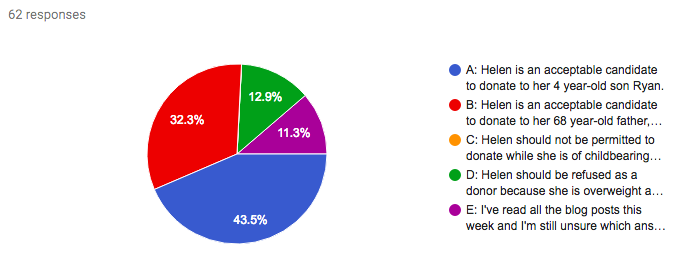
Here's how you responded:
Now, before you make a formal complaint, you’re absolutely right: this question would not hold water as a standardized board-level MCQ! There’s more than one correct answer. It’s controversial. And it’s perhaps not a direct test of the knowledge you’ve worked to acquire over the course of Living Kidney Donor Case Challenge.

However, every response from A through D is a real-life comment from a real-life nephrologist in an equivalent clinical scenario. So the range of responses from our #LKDCC community is not at all surprising. And if you chose E, don’t worry!

By following the whole week of #LKDCC, you’ve gained an insight into the available evidence regarding risks to kidney donor candidates. You’ve learnt about the risks of ESKD, proteinuria and pre-eclampsia. You’ve pondered the potential contribution of body composition, ethnic background, family history, dysglycaemia and age to these risks. You can confidently explain the ‘known knowns’ to would-be kidney donors. And hopefully you recognise the ‘known unknowns’ as well: the current gaps in evidence that are equally important to discuss with donors, but partly explain why there is such diversity between nephrologist attitudes in this field.  We all - doctors and patients - weigh unquantifiable risk differently: some are more conservative, others more adventurous.

So what does this mean for Helen? Helen is a motivated donor candidate with some risk factors for future metabolic and cardiovascular disease, including elevated BMI and family history. It’s essential that these are addressed in the informed consent process as we counsel Helen. We should explain to Helen how lifestyle choices could reduce her future risk of diabetes, discussing the benefits of weight loss and physical activity. She is of childbearing age, and therefore our consultation should also take into account her reproductive history and the potential impact of donation on any future pregnancy.

Is it important to us, as Helen’s medical advocate, who the intended recipient is? Arguably, it is not, except perhaps to establish that Helen’s relationship with the recipient is not complicated by coercion or exploitation. Our role is to assess Helen’s medical suitability as a donor, and to ensure she understands the implications of donation. As a mother who performs peritoneal dialysis for her son every day, and wishes for a long healthy life for him, Helen brings an understandably strong motivation for donation. As a donor to her father, Helen may be aware of the potentially shorter lifespan of the donated organ, but remain motivated to relieve her father of the burden of haemodialysis, thereby improving his survival and quality of life, and, by extension, her quality of life as a daughter and carer. Given the choice, as resource allocators, we would prefer to see Helen's kidney give benefit to a younger recipient - perhaps that explains why 43.5% of the #LKDCC team chose Option A. Similarly, if there were an alternative choice of donor, such as Helen's mother, whose lifetime risk may be lower than 37 year-old Helen, that risk differential should be clearly outlined in counselling Helen and her family.  Ultimately, when it comes to risk-benefit analysis in living kidney donation, there are no measurable medical benefits. The potential benefits are all psychosocial, and therefore only truly definable by each individual donor, after thorough counselling.

Living kidney donors don’t need paternalistic protection from unquantifiable long-term risks. They need our guidance, in providing them with all the available information to make a reasoned decision, while continuing the research required to expand the evidence base. They need our advocacy, firmly representing their individual needs in the multi-pronged transplant process. And they need our support to undertake a risk-benefit analysis that is truly unique across all of medicine.
Thank you for participating in #LKDCC: please give us your feedback here
Now you'll have a whole new perspective on Living Kidney Donor Risk
and the #NephMadness #TransplantRegion
Don't forget to submit your #NephMadness brackets here

Please note these are fictional cases with open access stock images. They do not represent real cases.
Created by Kate Robson (Nephrologist, Melbourne, Australia and NSMC Intern 2018)

Friday, March 23, 2018

#NephMadness Living Donor Case Challenge #LKDCC #5


Ari, 35, current power-lifting champion of New Zealand, wants to donate a kidney to his father, Tamati, 61, who has Type 2 diabetes and is on dialysis. His mother, who has diet-controlled diabetes and is in the obese weight range, has been excluded as a potential donor. Ari’s BMI is 29, and his BP is 130/90. Initial blood tests show serum creatinine = 105umol/L (1.19mg/dL),
eGFR= 77ml/min/1.73m2.

Which one of the following do you advise?

A) Ari should be excluded as a donor because his GFR is less than 90ml/min/1.73m2.
B) Ari’s BMI prohibits donation according to most guidelines.
C) If Ari’s fasting blood glucose is in the normal range, risk of diabetes does not need to feature in his pre-donation counselling.
D) Other testing in addition to fasting blood glucose may be required to assess Ari’s risk of dysglycaemia.


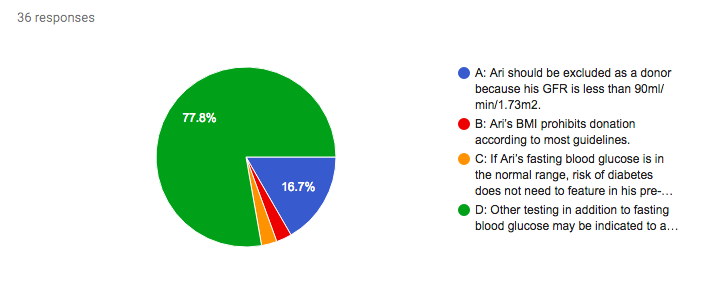
Here's how you responded:


Answer: D.

Accurately defining pre-donation kidney function is an important component of donor evaluation. While estimated GFR provides a good indication of kidney function, it may be less reliable in some situations, including extremes of body composition. Ari’s muscle mass might be considerable, in light of his occupation, affecting his creatinine generation. For assessment of potential kidney donors, KDIGO Guidelines recommend confirmation of measured GFR (mGFR) using a reference standard measure such as clearance of inulin, iohexol, Cr-EDTA or DTPA.

Donor nephrectomy involves the immediate loss of approximately 50% of nephron mass, and a resultant decrease in GFR. Adaptive hyperfiltration provides some compensation, however, increasing the single-kidney GFR by some 40%. According to the available evidence, the initial reduction in GFR after donation does not appear to lead to accelerated GFR loss in the medium term. A large meta-analysis including 5048 donors showed a decrease in average GFR from 111ml/min pre-donation to 86ml/min over 7 years after donation. In a novel approach, an older study examined 20-year donor follow-up with a control group comprising donors’ siblings. The reduction in GFR over time was similar in both groups.

Ari’s BMI indicates he is in the overweight range. His muscle mass again warrants consideration in interpreting this, however, and alternative measures such as waist circumference may be helpful. Evaluation of BMI is a key component of donor assessment. In the short term, we need to consider peri-operative risks conferred by obesity, such as prolonged operative time, venous thromboembolism and impaired wound healing. What about the longer term? Meta-analysis data shows an association, albeit modest, between obesity (BMI>30) and increased risk of ESKD in the general population (adjusted HR 1.16). Furthermore, in a 2017 study of more than 100,000 US kidney donors over 20 years, obese donors were significantly more likely to develop ESKD than non-obese donors matched for age, sex, ethnicity, blood pressure and baseline eGFR (HR 1.86). Most guidelines agree that BMI >35 is an absolute contraindication to donation, and recommend careful evaluation of donors with BMI>30, taking into account other risk factors.

Dysglycaemia is one such important risk factor. Type 2 diabetes is the leading cause of ESKD in New Zealand and Australia, as it is in the USA. Accordingly, Type 2 diabetes is usually considered a relative contraindication to kidney donation. Evidence is therefore very limited in diabetic donors. In a study of 2954 donors, 154 developed diabetes after donation. They were more likely to have hypertension and proteinuria than their non-diabetic counterparts, but no difference in eGFR was observed 8-26 years post-donation. Fasting blood glucose is recommended in all donor candidates. It may be insufficient to detect glucose intolerance, however, and pre-diabetic states are associated with increased risk of future diabetes and cardiovascular disease in the general population. KDIGO Guidelines therefore recommend 2-hour glucose tolerance testing for donor candidates with additional risk factors such as obesity or family history of diabetes. Pre-diabetes in a potential donor warrants very careful assessment of the predicted long-term risks according to age, lifestyle, family history and ethnicity.

Ari’s case invites us to reflect on the potential impact of ethnicity. We need to find out more about Ari’s background, as the indigenous Māori population of New Zealand have an elevated incidence of renal disease and early-onset diabetes. Indeed, across the world, cardiovascular and renal disease risk varies between ethnic groups, due to a likely combination of genetic factors, such as nephron endowment, and environmental factors, including historical and contemporary social determinants of health. Transplant centres vary in their approaches to these issues, and vigorous debate is ongoing. Should APOL1 genotyping be performed in all African American donor candidates, in light of the increased risk of kidney disease with high-risk genotypes? Is it unethical to accept an indigenous Australian kidney donor, given their elevated lifetime risk of ESKD? Or does a blanket refusal policy risk further disadvantaging the potential recipients, indigenous Australians with ESKD, in whom the transplantation rate is already well below the national average? Explore these questions in your own region of practice, and consider the far-reaching impact of our answers on both individuals and populations.

Ultimately, this case highlights the importance of holistic, individualised evaluation of donor risk. BMI of 27 or family history of diabetes may not be contraindications to donation as stand-alone risk factors. The combination in a young donor, however, together with additional demographic risk factors such as ethnicity, could confer significant additive risk.


Don't agree with the answer? Get on twitter and tell us what you think...
Submit your responses for Case 6 now!
Complete the 7-day challenge and you'll have a whole new perspective on Living Kidney Donor Risk
and the #NephMadness #TransplantRegion
Don't forget to submit your #NephMadness brackets here

Please note these are fictional cases with open access stock images. They do not represent real cases.
Created by Kate Robson (Nephrologist, Melbourne, Australia and NSMC Intern 2018)

Thursday, March 22, 2018

#NephMadness Living Kidney Donor Case Challenge #LKDCC #4


Beatriz, 62, presents as a potential kidney donor for her son Miguel. Her BP is 130/85, and BMI 26. She has no personal or family history of diabetes or cardiovascular disease. She brings some blood and urine test results from her primary care provider, including eGFR = 90ml/min/1.73m2, and urine albumin:creatinine ratio (ACR) = 8mg/mmol, or 70mg/g.

A) Beatriz is ineligible as a donor because we have diagnosed microalbuminuria.
B) Population studies indicate that higher albuminuria is associated with higher risk of ESKD, cardiovascular disease and death.
C) We should counsel Beatriz that studies show increasing proteinuria after donation leads to poor outcomes.
D) This uACR result would be more acceptable if Beatriz were 42, instead of 62, as her lifetime risk of kidney disease would be lower.


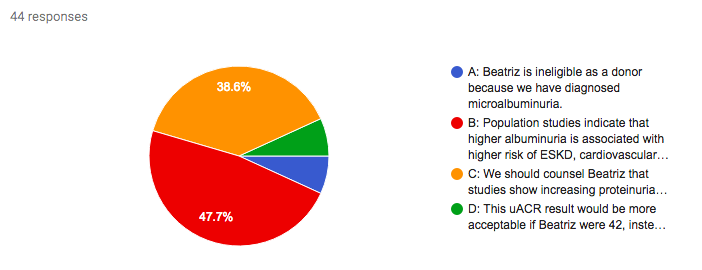
Here's how you responded:
Answer: B.

Albuminuria is an established risk factor for CKD and cardiovascular events in the general population. Potential kidney donors should undergo a screening test: both KDIGO and UK BTS Guidelines recommend urinary albumin:creatinine ratio. An abnormal result should be confirmed with a repeat sample (or, per KDIGO, determination of the albumin excretion rate from a timed sample). It is widely agreed that high levels of albuminuria are a contraindication to donation: the 2005 Amsterdam Forum agreed on exclusion of donors with  >300mg/day,and a 2007 US survey found many centres used a threshold of 150mg/day. KDIGO Guidelines now recommend exclusion of candidates with albuminuria of >100mg/day. The potential risks for donors with lower baseline levels of albuminuria are much less clear, however, with limited evidence for this group. In one study of 70 donors, those 5 with low-level proteinuria at baseline were more at risk of significant proteinuria (>800mg/day) at follow-up, but this was not associated with reduced kidney function.

Incident proteinuria is a recognised post-donation phenomenon, and has been hypothesised to represent hyperfiltration. A meta-analysis by Garg et al demonstrated a 12% pooled incidence of proteinuria at 7 years post-donation. Closer analysis of 3 controlled studies found a higher level of proteinuria in donors (147mg/day) compared with controls (86mg/day). The clinical relevance of this is really not clear, however. Ibrahim et al found that 11.5% of 255 donors developed incident microalbuminuria, but these donors had a higher measured GFR at follow-up than those without albuminuria, and none had a GFR of less than 45ml/min.

While microalbuminuria is not generally considered an absolute contraindication to donation, these candidates need careful evaluation to consider the underlying cause, as well as other risk factors for cardiovascular disease, such as hypertension and increased BMI. Remember that while older donors may be more likely to have albuminuria and other comorbidities requiring careful assessment, they have fewer years of life ahead of them. Therefore, their lifetime risk of ESKD is lower than an otherwise similar younger donor. Use this risk tool to see how different parameters affect lifetime risk.

Don't agree with the answer? Get on twitter and tell us what you think...
Submit your responses for Case 5 now!
Complete the 7-day challenge and you'll have a whole new perspective on Living Kidney Donor Risk and the #NephMadness #TransplantRegion
Don't forget to submit your #NephMadness brackets here

Please note these are fictional cases with open access stock images. They do not represent real cases.
Created by Kate Robson (Nephrologist, Melbourne, Australia and NSMC Intern 2018)

Wednesday, March 21, 2018

#NephMadness Living Kidney Donor Case Challenge #LKDCC #3


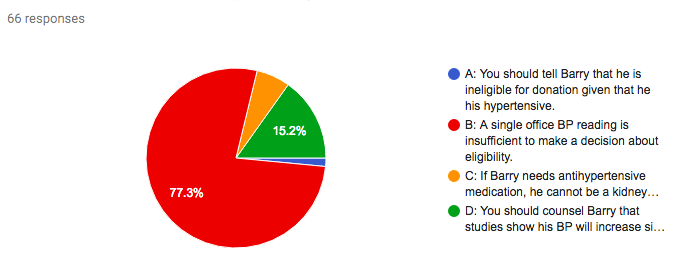
Barry, 62, is under evaluation as a kidney donor to his wife Susan.
At his first appointment, you measure his blood pressure at 155/95.
Which one of the following is correct?
A) You should tell Barry that he is ineligible for donation given that he his hypertensive.
B) A single office BP reading is insufficient to make a decision about eligibility.
C) If Barry needs antihypertensive medication, he cannot be a kidney donor.
D) You should counsel Barry that studies show his BP will increase significantly after kidney donation.


Here's how you responded:

Answer: B.

The impact of kidney donation on blood pressure is not clearly defined. Studies in this area have been limited by small numbers, heterogeneous parameters, and absence of suitable control groups.

While there are several earlier studies without a comparator group, more recent research comparing blood pressure in donors with a matched control group provide more useful information. Ibrahim et al compared 255 donors from their larger Minnesota cohort with a matched control group, and found no statistically significant difference in the proportion of those with blood pressure of 140/90 or higher (14.4% donors vs 18.7% controls). A 2006 meta-analysis examined pooled data for a total of 5145 donors from 9 controlled studies (comparing donors with healthy adults matched for age, sex and ethnicity). A small increase in blood pressure (6mmHg systolic and 4mmHg diastolic) was noted in donors over 10-year follow-up. Finally, a 2015 prospective study of 182 living donors and 171 matched controls found a (very!) small increase in blood pressure (2/1mmHg) after 3 years, with no significant difference between the two groups.

Our knowledge of outcomes for donors with pre-donation hypertension is even more limited. Textor et al reported on 148 Caucasian donors, before and up to 12 months after donation. 24 donors had hypertension at baseline (average ambulatory blood pressure greater than 135/85mmHg, or on antihypertensive treatment). These donors were older and had a higher BMI than normotensive donors. They had normal GFR and no proteinuria, and were treated with both pharmacological and non-pharmacological methods to control blood pressure. There was no significant increase in blood pressures (indeed, a slight decrease), in this very short follow-up period.

There is no clear evidence that kidney donation increases the risk of hypertension in most donors. Higher blood pressure, BMI and age do, however, confer greater risk in potential donors, as in the general population. As recommended by KDIGO Guidelines, pre-donation assessment should involve at least 2 office measurements of blood pressure and, where there’s uncertainty/variability, ambulatory blood pressure monitoring. Where blood pressure can be controlled with 1 or 2 agents, and there is no end-organ damage, hypertension alone is not considered a contraindication to donation. Pre-donation, individualized risk assessment, careful counselling and optimisation of risk factors is essential. Afterwards, close follow-up for management of hypertension and secondary prevention strategies for cardiovascular disease is key.

Don't agree with the answer? Get on twitter and tell us what you think...
Submit your responses for Case 4 now!
Complete the 7-day challenge and you'll have a whole new perspective on Living Kidney Donor Risk and the #NephMadness #TransplantRegion
Don't forget to submit your #NephMadness brackets here

Please note these are fictional cases with open access stock images. They do not represent real cases.
Created by Kate Robson (Nephrologist, Melbourne, Australia and NSMC Intern 2018)

Tuesday, March 20, 2018

#NephMadness Living Kidney Donor Case Challenge #LKDCC #2


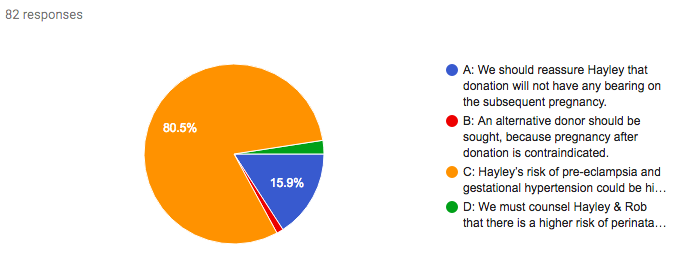
Hayley, 30, wishes to donate a kidney to her husband Rob.  They have a 3 year-old child. Hayley has no known medical problems and is a non-smoker. Her BMI is 23 kg/m2, her blood pressure is 110/70 mmHg and physical examination is unremarkable. The urinalysis shows no haematuria or proteinuria. Her measured eGFR is 104ml/min/1.73m2.
If Hayley and Rob decide to have another child after donation,
A) We should reassure Hayley that her kidney donation will not have any bearing on the subsequent pregnancy.
B) An alternative donor should be sought, because pregnancy after donation is contraindicated.
C) Hayley’s risk of pre-eclampsia and gestational hypertension could be higher than in her first pregnancy.
D) We must counsel Hayley & Rob that there is a higher risk of perinatal death with the subsequent pregnancy.


Here's how you responded:

Correct Answer: C

A 2015 Canadian retrospective cohort study examined 85 female kidney donors, comparing them with 510 healthy non-donors matched for age, income, rurality, and number of previous pregnancies. There were 131 (post-donation) pregnancies in donors, and 788 in the control group. Gestational hypertension and pre-eclampsia were more common in the donor group (11% vs 5%) but there were no differences in rates of preterm birth or low birth weight, and no maternal or perinatal deaths. The study is limited by the lack of detailed information contributing to the diagnoses, such as blood pressures, GFR and urinalysis. It is possible that a coded diagnosis of pre-eclampsia was more likely to be made in a donor, due to more intensive surveillance or baseline proteinuria.

A Norwegian study of 326 female donors compared pregnancies before and after donation. Gestational hypertension or pre-eclampsia complicated 8% of pregnancies after donation, compared with 2.6% of pre-donation pregnancies.
There was an additional comparison between donor and non-donor pregnancies from a national birth registry, although baseline prognostic factors differed significantly between these groups, including a difference in average maternal age of 5 years.

Also comparing pregnancies before and after donation, a single-centre study in Minnesota collected self-reported data from 1085 women. While post-donation pregnancy outcomes were similar to those reported in the general population USA-wide, they were inferior to pre-donation outcomes (e.g. pre-eclampsia: 5.5% vs 0.8%). The study was based on patient recall alone, and saw a loss to follow-up of almost 40%. We should also consider that women with a history of gestational hypertension or pre-eclampsia may be less likely to become kidney donors, potentially resulting in an exaggerated difference between pre-donation and post-donation pregnancy outcomes in both this and the Norwegian study.

The available evidence suggests that kidney donation does not increase the risk of pregnancy complications above that of the general population. There may be an increase in risk of gestational hypertension and pre-eclampsia compared with pre-donation rates, but this has not been shown to result in higher rates of maternal or fetal death.

To help this family make the best decision for them, we should counsel Hayley and Rob about the available information, and put this into context for Hayley’s individual situation. Hayley and Rob’s family planning is not itself a contraindication to donation.


Don't agree with the answer? Get on twitter and tell us what you think...
Submit your responses for Case 3 now!
Complete the 7-day challenge and you'll have a whole new perspective on Living Kidney Donor Risk and the #NephMadness #TransplantRegion
Don't forget to submit your #NephMadness brackets here

These are fictional cases with open access stock images and do not represent real cases.

Created by Kate Robson (Nephrologist, Melbourne, Australia & NSMC Intern 2018)

Monday, March 19, 2018

#NephMadness Living Kidney Donor Case Challenge #LKDCC #1


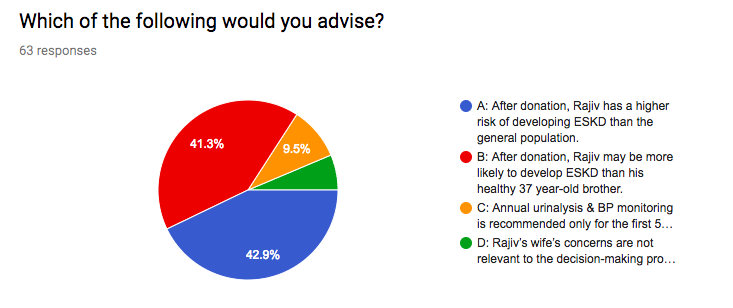
Rajiv, 39, wants to donate a kidney to his sister-in-law, Shen. His brother, Shen’s husband, is healthy, but unfortunately not a good match for Shen. Rajiv has no past medical history, is a non-smoker and his BMI is 24. His BP is measured at 120/75. Physical examination and urinalysis are unremarkable. Rajiv’s wife is particularly concerned about the future risks to Rajiv.

Which of the following would you advise?
A) After donation, Rajiv has a higher risk of developing ESKD than the general population.
B) After donation, Rajiv may be more likely to develop ESKD than his healthy 37 year-old brother.
C) Annual urinalysis & BP monitoring is recommended only for the first five years after donation.
D) Rajiv’s wife’s concerns are not relevant to the decision-making process.


Here's how you responded:


Correct Answer: B
For many years, potential kidney donors responding to the call to ‘Share your Spare’ were counselled that donation did not increase their risk of kidney failure. This advice was based on data showing that the rate of ESKD among kidney donors was equal or indeed lower than in age-matched controls (see e.g. these studies from 1997 and 2009). But, owing to stringent pre-donation assessment, as well as follow-up care afterwards, donors are usually particularly healthy compared with the rest of the population. It makes more sense, therefore, for studies to compare donors with matched healthy controls.  That was the approach taken by two more recent studies.

In the first, Mjoen et al compared 1901 Norwegian donors with a control group of 32,621 people who would have been deemed fit for donation. Median follow-up time was 15.1 (range 1.5-43.9) and 24.9 (range 0.1-26) years respectively. ESKD ensued in 9 (0.47%) donors and 22 (0.07%) controls, which corresponds to a hazard ratio for donors of 11.38, but a very small absolute increase in risk (i.e. 11 times almost zero). There are several methodological issues to consider, too. The mean age at baseline was significantly higher in donors than in non-donors (46 vs 37.6 years). The longer maximum follow-up for donors may also have led to a higher detection rate of ESKD. Furthermore, 80% of donors were first-degree relatives of the recipient, (unrelated donors were first accepted in Norway in 1983), and 7/9 donors who developed ESKD had a primary renal disease, suggesting genetic factors may be important.

Shortly after, Muzaale et al reported the long-term outcomes of 96,217 donors in the USA, with a control group from the NHANES III study matched for age, sex, race, education, BMI, smoking status and blood pressure. Median follow-up was 7.6 years for donors and 15 years for non-donors. ESKD was seen in 99 (0.1%) donors, compared with 36 (0.04%) non-donors (p<0.001). Estimated lifetime risk of ESKD was 90 per 10,000 in donors, compared with 14 per 10,000 in matched healthy non-donors and 326 per 100,000 in the general population. In subgroup analysis, a higher cumulative incidence of ESKD was noted in African-American donors and in donors aged over 60 years at the time of donation.

These two studies suggest that, when compared with a matched healthy population, donors have a higher relative risk of ESKD in the long term. This information should be part of the consent process for potential donors, particularly for those with additional risk factors. Nonetheless, the absolute risk remains very low, and substantially lower than in the general population.

Of course, when counselling an individual about their long-term post-donation risk of ESKD, it's important to think about their baseline (pre-donation) risk: this risk tool can help you see how different factors impact an individual's baseline (pre-donation) risk of ESKD.

Long-term annual follow-up is widely recommended for living kidney donors  (see e.g. KDIGO Guidelines and UK BTS Guidelines), and should address not only renal function, but cardiovascular risk factors, lifestyle factors and psychosocial well-being. This responsibility is particularly important in considering overseas donors.

Finally, thinking about Rajiv’s wife’s concerns, psychosocial support is essential for successful kidney donation. A multi-national qualitative study found that in the very small proportion of donors who reported a negative impact on quality of life after donation, family discord and lack of support were key risk factors.


Don't agree with the answer? Get on twitter and share your thoughts...
Submit your responses for Case 2 now!
Complete the 7-day challenge and you'll have a whole new perspective on Living Kidney Donor Risk and the #NephMadness #TransplantRegion
Don't forget to submit your #NephMadness brackets here

Please note these are fictional cases with open access stock images. They do not represent real cases.

Created by Kate Robson (Nephrologist, Melbourne, Australia and NSMC Intern 2018)